
Validating problems or solutions
Reflecting back on my journey with zentor.ai and where I'm going next

I’ve spent a lot of time reflecting on my progress with zentor.ai, my new software tool for coaching teachers. I’ve shared my why behind zentor.ai and how I went from idea to actual software.
But how’s it actually going?
Oh man. There’s a lot to unpack. Let’s get into it.
Getting feedback on my feedback tool
It’s February 2024. zentor.ai was ready for folks to use. I was nervous. Also excited, but mostly nervous.
I had a list of folks I wanted to use it. I knew I needed a way to communicate how it worked. And I knew I needed to do follow up interviews or surveys to get feedback.
I started with the video. Drafted a script, rewrote it. Recorded, deleted, recorded again. It was surprisingly fun. And super draining. I don’t know how people make videos on YouTube every day.
I came up with a survey and three interview questions. Sent it all out.
Then waited. Waited. Waited.
In my head, I thought it was going to take hours to get the feedback. But it was months. My first interview was February 27th. I had one last week (April 30th).
But it was worth it, because I learned a lot. The seven folks I’ve talked with were incredibly gracious with their time and candid with their feedback. They shared their experiences and their advice. Most kept talking through the twenty minutes we had scheduled and were eager to check out a second version.
And it was probably around the fourth interview that I realized I was doing it all wrong.
You see, I had sent out a tool for feedback. Just like I would do with a client who had asked me to solve a specific problem. I had a created a solution and established ways to generate feedback.
But I didn’t know if the problems I wanted to solve were actually problems.
Validating a problem vs. a solution
Last week, I talked about building vs. validating. I had built a tool - my software - because I didn’t know how to validate my idea for zentor.ai.
But here’s the thing: it’s not about validating an idea or a solution. I needed to validate the problem. I needed to know that other people were experiencing what I was experiencing.
I had been struggling with the concept of explaining zentor.ai without a prototype. Which I think is reasonable. But I shouldn’t have been trying to think of how to explain the solution. I should have been thinking about how to understand the problem.
I had started to come to this realization during the interviews, but it was really solidified for me on a run (not surprising, I know). I was listening to the audio version of Deploy Empathy by Michele Hansen, and she was describing the concept of a discovery interview. She talked through the purpose (understanding people’s experiences) and shared some sample questions to ask. I stopped running and just shook my head.
Luckily, I had listened to this part of the book before I had my interview last week. I quickly changed up the questions I had been using:
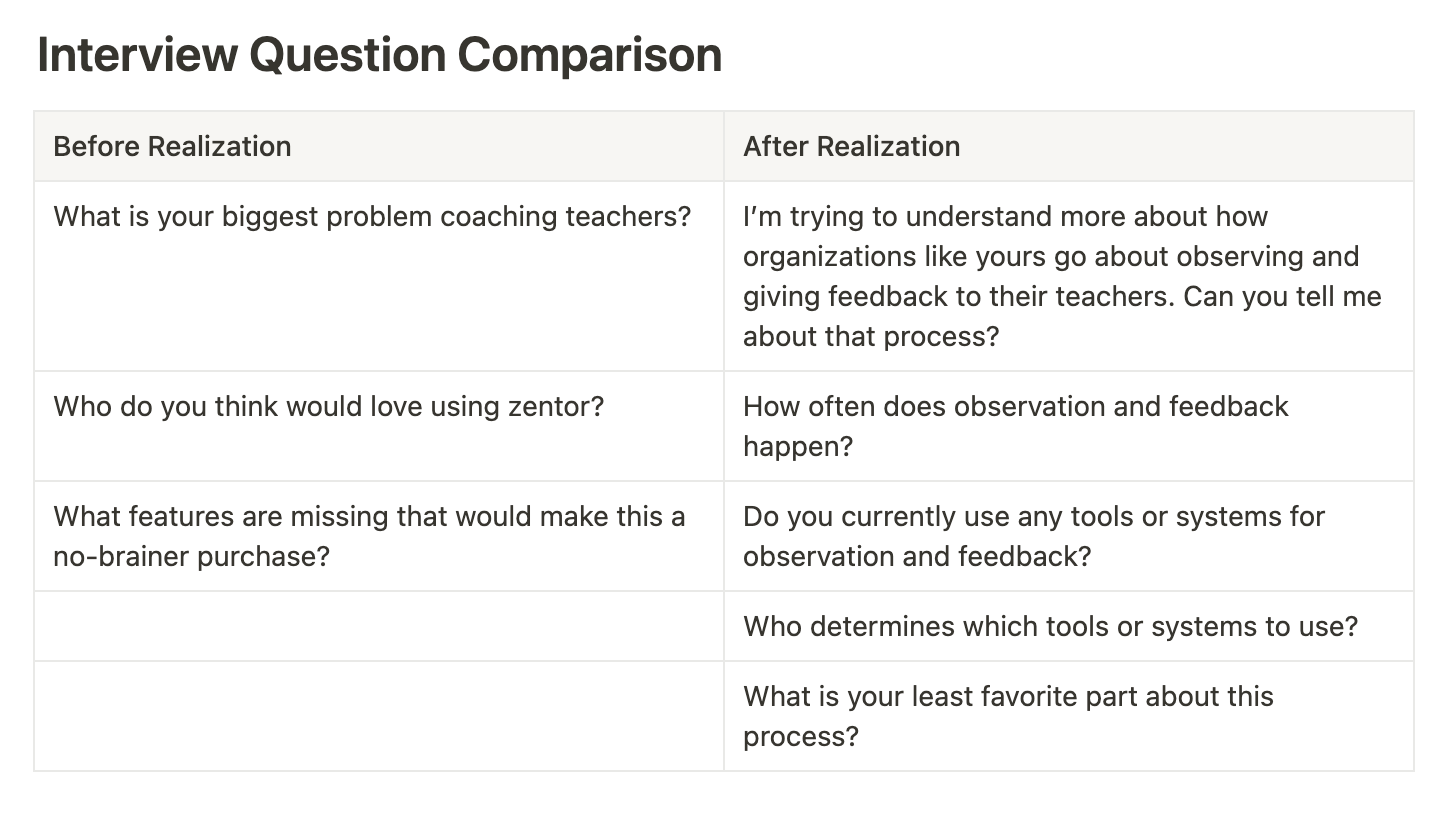
Notice any differences? My last interview - where I used these new questions - was totally different than the first six. It was like 30 minutes of constant learning. The person I spoke with described a completely different approach to feedback and observation. It was like a whole new world was opened up to me.
And it wasn’t just the questions. The whole conversation felt different. I barely spoke. I didn’t share any of my experiences or ideas. It was all about the person being interviewed and their problems. And their solutions. The conversation didn’t validate a need for zentor.ai at all, but it did make me realize that I needed to learn more.
Where to go next?
When I look back at my plan for February, my goal was to have the 2.0 version of zentor.ai ready to launch by summer. With payment options and a marketing plan.
Yeah, that’s not happening.
To be honest, I’m not totally sure what to do with zentor.ai at the moment - from a development perspective. My interviews and surveys helped me realize that a 2.0 version likely needs to be faster, have better analytics, provide insights to multiple types of users, and potentially be focused on a tighter niche - like new coaches or coaches for STEM subjects. Or to be a complete observation-feedback tool for a school district. And yes, I know those two last statements are in complete opposition to each other.
What I do know is that I need to learn more. To spend more time talking with folks about their problems. This means talking with actual coaches - and coaches of coaches. People who are doing this work everyday and experience the problems first-hand.
So, I’m setting a goal. Over the next three months (May, June, July), I want to speak with 12 people. Michele, in Deploy Empathy, notes that you can get 80% of the ideas with 12 people and 90% with 20 people. I’m going to be reaching out to folks starting tomorrow. And I’m not going to be validating zentor.ai. I’m going to be asking them about their problems.
Thanks for coming along this journey with me. It feels like I’m at this important moment of figuring out how to pivot/look for something else/I’m not sure what else. And I appreciate having a space to share these ideas each week.
Let’s go.